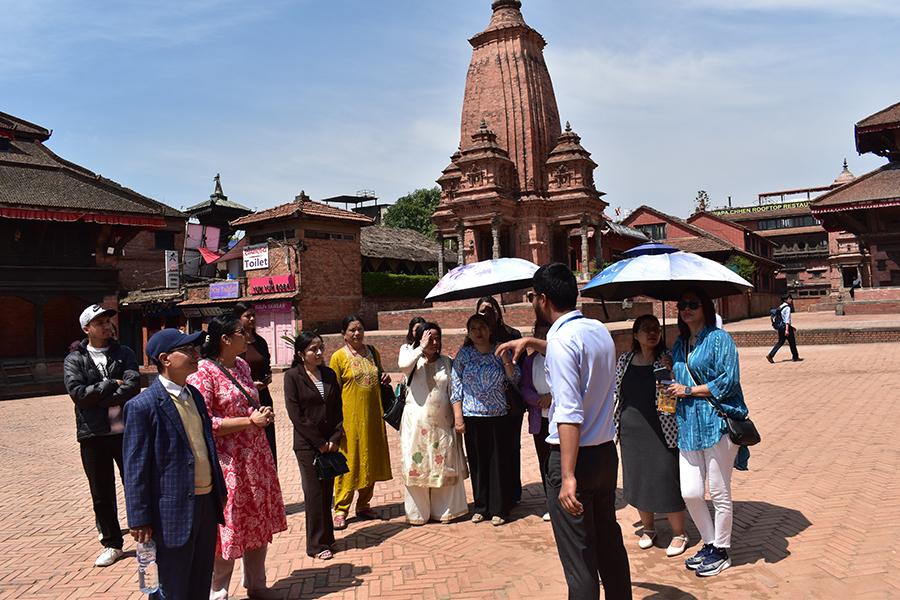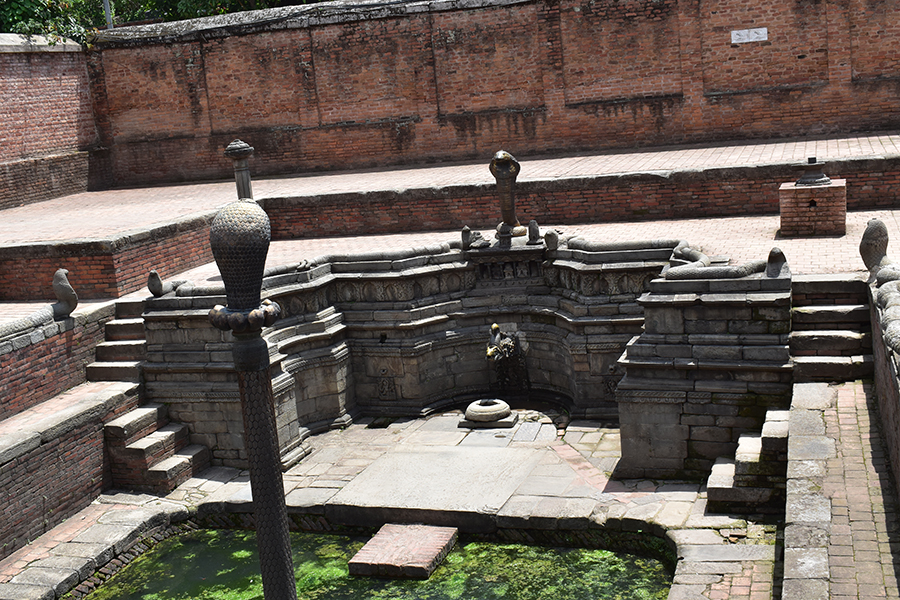
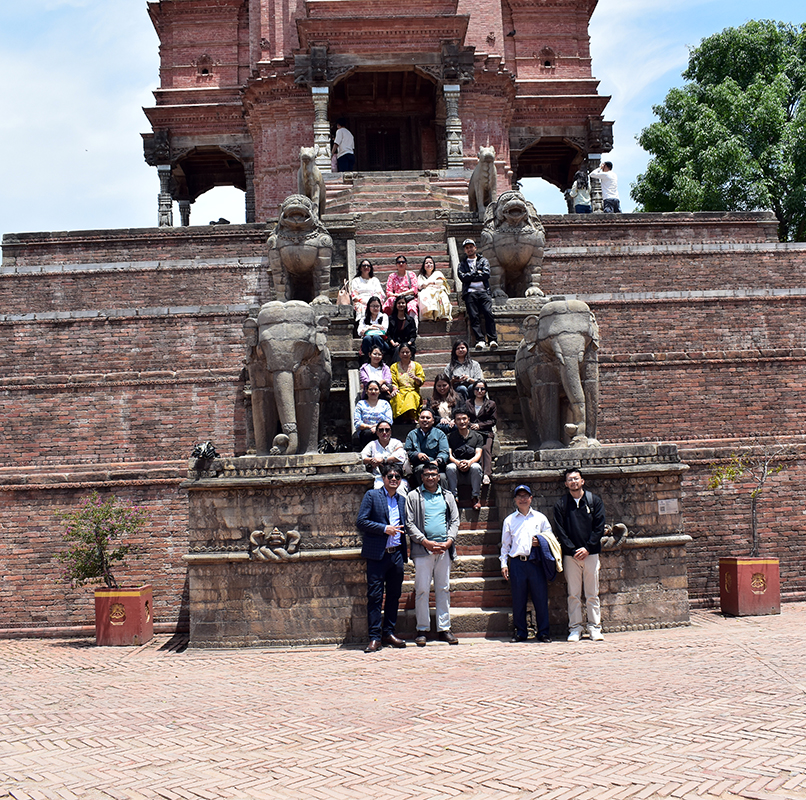
A Study Visit to Bhaktapur Durbar Square UNESCO World Heritage Site, Bhaktapur, Nepal
|
Submitted by: |
Academia Team |
|
Date of Visit: |
10th May 2025 |
|
Location: |
Bhaktapur Durbar Square, Bhaktapur, Bagmati Province, Nepal |
|
Heritage Status: |
UNESCO World Heritage Site (inscribed 1979) |
|
Purpose: |
Academic Field Study & Heritage Research |
1. Abstract
This field study report documents the academic visit conducted by the Academia Team to Bhaktapur Durbar Square, Bhaktapur, Nepal, on 10th May 2025. The visit was undertaken as part of a structured research initiative aimed at examining the architectural, historical, and socio-cultural dimensions of one of Nepal’s most significant UNESCO World Heritage Sites. This report presents observational findings, contextual analysis, and reflections derived from on-site study, with particular attention to the Newari architectural tradition, the preservation of intangible cultural heritage, and the challenges inherent in managing living heritage sites within contemporary urban contexts. The study concludes with recommendations for further academic inquiry and heritage education.
2. Introduction
Bhaktapur Durbar Square, situated in the ancient city of Bhaktapur approximately 13 kilometers east of Kathmandu, constitutes one of the most architecturally and historically significant ensembles in South Asia. Recognized by the United Nations Educational, Scientific and Cultural Organisation (UNESCO) as a World Heritage Site in 1979, the square represents the apex of Newari civilisation, a cultural tradition indigenous to the Kathmandu Valley that flourished particularly during the Malla dynasty (12th–18th century CE).
The academia team undertook this field visit with the primary objective of supplementing theoretical knowledge with direct empirical observation. Heritage sites of this nature offer an irreplaceable pedagogical resource: they present architecture, material culture, ritual practice, and urban morphology in an integrated, living context that no secondary source can fully replicate.
The study was guided by the following research questions:
- What are the defining architectural characteristics of Bhaktapur Durbar Square, and how do they reflect the Newari cultural and religious worldview?
- How has the site been preserved and managed since its UNESCO designation, particularly in the aftermath of the 2015 Gorkha earthquake?
- What is the relationship between the living community of Bhaktapur and the heritage structures they inhabit and use daily?
- What pedagogical and research opportunities does a site of this nature present for academic teams engaged in cultural heritage studies?
3. Site Background and Historical Context
3.1 Origins and Historical Significance
Bhaktapur, historically known as Khwopa, was established as a major urban settlement in the 9th century CE and rose to prominence as the capital of the entire Kathmandu Valley during the reign of King Yaksha Malla (1428–1482 CE). Following the division of the valley kingdom in the late 15th century, Bhaktapur became the seat of one of three independent Malla kingdoms, the others being Kathmandu (Kantipur) and Patan (Lalitpur). This period of political fragmentation paradoxically produced an extraordinary florescence of art, architecture, and urban planning, as each kingdom sought to outdo the others in the magnificence of its public monuments.
The Durbar Square complex, which served as the ceremonial and administrative heart of the Bhaktapur kingdom, reached its current form largely through construction and renovation during the 17th and early 18th centuries. The square contains over 55 temples, palaces, courtyards, and water features, representing multiple building campaigns spanning several centuries.
3.2 UNESCO World Heritage Designation
Bhaktapur Durbar Square forms part of the Kathmandu Valley World Heritage Site, inscribed on the UNESCO World Heritage List in 1979 under criteria iii, iv, and vi. The inscription recognized the site’s outstanding universal value as a testimony to the Newari civilization, its exceptional ensemble of religious and palace architecture, and its living traditions of craftsmanship, ritual, and community organization.
The site’s Outstanding Universal Value (OUV) is articulated around three primary attributes: the integrity of the urban fabric, the continuity of intangible heritage practices, and the quality of the architectural and artistic heritage.
4. Methodology
The field study was conducted using a qualitative, observational methodology consistent with established practices in heritage research and cultural studies. The team employed the following data collection strategies:
4.1 Direct Observation
Team members conducted systematic walkthroughs of the Durbar Square complex, including the primary square, subsidiary courtyards, and adjacent lanes. Observations were recorded in field notebooks, with particular attention to architectural typology, material condition, use patterns, and spatial organization.
4.2 Photographic Documentation
Photographic records were made of key architectural elements, decorative programs, landscape features, and human activity within the site. All photography was done in accordance with site rules and with respect for ongoing religious observances.
4.3 Contextual Literature Review
Prior to the visit, the team undertook a structured review of relevant academic literature, including UNESCO management plans, conservation reports, and peer-reviewed scholarship on Newari architecture and the cultural heritage of the Kathmandu Valley.
4.4 Informal Dialogue
Brief, unstructured conversations were conducted with local residents, artisans, and heritage custodians encountered during the visit. These exchanges, while not constituting formal interviews, provided valuable emic perspectives on the site’s significance and management.
5. Key Findings and Observations
5.1 Architectural Heritage
5.1.1 The 55-Window Palace (Pachpanna Jhyale Durbar)
The 55-Window Palace, built in the early 18th century during the reign of King Bhupatindra Malla, is probably the best-preserved example of Newari palace architecture. The palace’s principal facade features 55 individually carved wooden windows, each a distinct artistic composition incorporating deities, mythological creatures, and geometric motifs rendered in exquisite polychrome woodwork. The field team devoted considerable time to the systematic study of these panels, noting the remarkable variation in the iconographic program and the evidence of multiple restoration campaigns, visible in the quality and style of individual carvings.
Of particular academic interest is the use of the trapezoidal window form, a characteristic Newari feature that recurs throughout the complex, which creates a distinctive rhythm of light and shadow across the facade that transforms dynamically through the day.
5.1.2 Nyatapola Temple
The Nyatapola Temple (c. 1702 CE), at approximately 30 meters the tallest structure in the complex, is universally acknowledged as the masterwork of Newari pagoda architecture. Commissioned by King Bhupatindra Malla and completed in a single building campaign, it stands as evidence of the extraordinary organizational and technical capacity of the Malla state. The temple is dedicated to the tantric goddess Siddhi Lakshmi, whose image is accessible only to initiated priests; this condition of restricted access itself constitutes an important dimension of the site’s intangible heritage.
The team undertook a structural observation of the temple’s tiered plinth, noting the progressive reduction in scale of the guardian figures stationed at each level: wrestlers (Jaya-Pratap Malla and Bhairav), elephants, lions, griffins, and finally the goddesses Baghini and Singhini, whose combined supernatural strength is said to be ten times that of each lower guardian. This encoding of cosmological hierarchy in monumental sculpture constitutes a sophisticated integration of architectural and theological meaning.
5.1.3 The Golden Gate (Sun Dhoka)
The Golden Gate, dating from 1753 CE, provides the principal entrance to the 55-Window Palace complex. Constructed in gilt copper repoussé, the gate features a richly detailed torana (tympanum) depicting the goddess Taleju Bhawani surrounded by attendant deities, serpents, and celestial figures. The craftsmanship is widely regarded as the finest example of metal repoussé work in the subcontinent. The field team noted the complexity of the iconographic program and the technical virtuosity of the metalwork, which retains exceptional detail despite centuries of exposure.
5.2 Living Heritage and Community
A key observation of the field study was the degree to which Bhaktapur Durbar Square functions as an active living heritage site rather than a static museum environment. During the visit, the team saw people doing daily rituals at several shrines, people using the steps and courtyards of the temple to socialize, artisans working in nearby workshops, and children playing in areas that have been used for similar purposes for hundreds of years.
This vitality is simultaneously the site’s greatest strength and a significant management challenge. The presence of a living community ensures the continuity of intangible heritage practices, rituals, festivals, craft traditions, and oral knowledge systems—that provide the physical structures their full meaning. However, it also creates tensions between conservation requirements and the legitimate needs and rights of resident communities.
5.3 Post-Earthquake Recovery and Conservation
The 2015 Gorkha Earthquake (Mw 7.8) caused significant damage to numerous structures within the Bhaktapur complex. Evidence of both damage and ongoing restoration was visible throughout the site at the time of the field visit. The team observed scaffolded structures at several locations, as well as areas where workers had installed temporary protective roofing over damaged masonry.
The post-earthquake recovery effort at Bhaktapur has attracted international attention as a case study in the management of earthquake-damaged World Heritage Sites. Notably, Bhaktapur sustained comparatively less damage than Kathmandu and Patan Durbar Squares, a fact attributed in part to the higher quality and better-maintained traditional masonry construction still prevalent in the city.
5.4 Pottery Square and Traditional Crafts
The team’s itinerary included a visit to Talako Tole (Pottery Square), a short distance from the main Durbar Square complex. Here, the continuation of traditional ceramic production using foot-operated potter’s wheels provided a direct illustration of the relationship between intangible heritage and the physical landscape of the city. The concentration of ceramic production in this quarter reflects a long-established system of caste-based occupational specialization (the Prajapati caste), which structured the economic and spatial organization of Newari cities.
6. Analysis and Discussion
6.1 Architectural Synthesis and Cultural Expression
The architectural vocabulary of Bhaktapur Durbar Square constitutes a coherent system of cultural expression in which spatial organization, structural form, material culture, and iconographic program are integrated into a unified whole. The pagoda form, derived from earlier timber construction traditions, encodes a cosmological model in which the tiered structure represents the axis mundi connecting earthly and divine realms. The use of the square (mandala) as the generative principle of urban planning reflects the influence of Hindu and Buddhist cosmological thought on Newari city-building.
The concentration of temple building activity in the 17th and early 18th centuries reflects the particular political conditions of the later Malla period, in which inter-kingdom rivalry and the patronage competition between kings produced an extraordinarily dense accumulation of monumental architecture within a relatively confined urban area. The result is an architectural landscape of remarkable richness and complexity that repays sustained scholarly attention.
6.2 Heritage Management Considerations
The field study raised important questions regarding the management of living heritage sites. The Bhaktapur Municipality has implemented an entry fee system for foreign visitors since the 1980s, revenue from which funds conservation activities and local infrastructure. This model, while controversial in some heritage management circles, has become a widely cited example of successful locally managed heritage tourism. At the time of the visit, the system appeared to be functioning effectively, with visible evidence of ongoing conservation work throughout the complex.
However, the team also observed tensions between tourism activity and the site’s primary function as a living community. Visitor numbers, while lower than in Kathmandu, were sufficient to create congestion at key locations, particularly around the Nyatapola Temple and the Golden Gate. The management of visitor flow in a way that respects both the heritage values of the site and the daily life of its resident community represents a continuing challenge for site managers.
7. Educational and Research Value
The field visit to Bhaktapur Durbar Square yielded significant educational value across multiple dimensions of the team’s academic program:
- Architecture and urban morphology: Direct observation of the site revealed a Newari spatial organization, structural systems, and decorative programs that substantially enriched the team’s understanding of these topics beyond what is available through secondary sources.
- Heritage management: The site serves as an invaluable case study in the management of a living World Heritage Site, illustrating both successful practices and ongoing challenges that are relevant to broader theoretical frameworks in heritage studies.
- Intangible cultural heritage: Observation of active ritual practices, craft production, and community use of heritage spaces provided concrete illustrations of the relationship between tangible and intangible heritage dimensions.
- Post-disaster recovery: Evidence of the ongoing recovery effort following the 2015 earthquake provided a real-world context for understanding the challenges of heritage conservation in disaster-affected settings.
- Interdisciplinary synthesis: The complexity of the site, encompassing architectural history, religious studies, anthropology, urban planning, and conservation science, provided an opportunity for interdisciplinary thinking rarely available in a classroom setting.
8. Conclusion
The Academia Team’s field study visit to Bhaktapur Durbar Square on 10th May 2025 constituted a significant and highly productive academic undertaking. The site’s extraordinary richness — architectural, historical, cultural, and social — provided an exceptional environment for empirical learning and observational research. The visit substantially enriched the team’s theoretical knowledge through direct engagement with a complex, multi-layered heritage landscape.
The study has also generated several directions for further academic inquiry, including comparative analysis of the three Kathmandu Valley Durbar Squares, detailed investigation of post-earthquake conservation methodologies, and deeper examination of the relationship between heritage tourism and community well-being in Bhaktapur.
It is the strong recommendation of the field study team that visits of this nature be systematically integrated into the academic program as a core component of heritage and cultural studies education. The pedagogical value of direct engagement with living heritage sites is substantial and, in important respects, irreplaceable.
9. References and Further Reading
Bernier, R. M. (1997). The Nepalese Pagoda: Origins and Style. S. Chand & Co.
Korn, W. (1976). The Traditional Architecture of the Kathmandu Valley. Bibliotheca Himalayica.
Levy, R. I. (1990). Mesocosm: Hinduism and the Organization of a Traditional Newar City in Nepal. University of California Press.
Tiwari, S. R. (2009). The Ancient Towns of Nepal. HMG Press, Department of Archaeology.
UNESCO World Heritage Centre. (2020). Kathmandu Valley: State of Conservation Report. UNESCO.
Wegner, G., & Vajracharya, G. V. (2001). The Newars of the Kathmandu Valley: Art, Architecture, and Culture. Vajra Publications.